AI-Assisted vs Professional Next.js Development: When to Use AI, When to Hire a Team
AI can generate websites and systems quickly, but business-critical projects need careful attention to business logic, security, databases, API integrations, performance, scalability and maintenance. Learn when to rely on AI, when to hire a Next.js team, and how a hybrid approach saves time and cost.
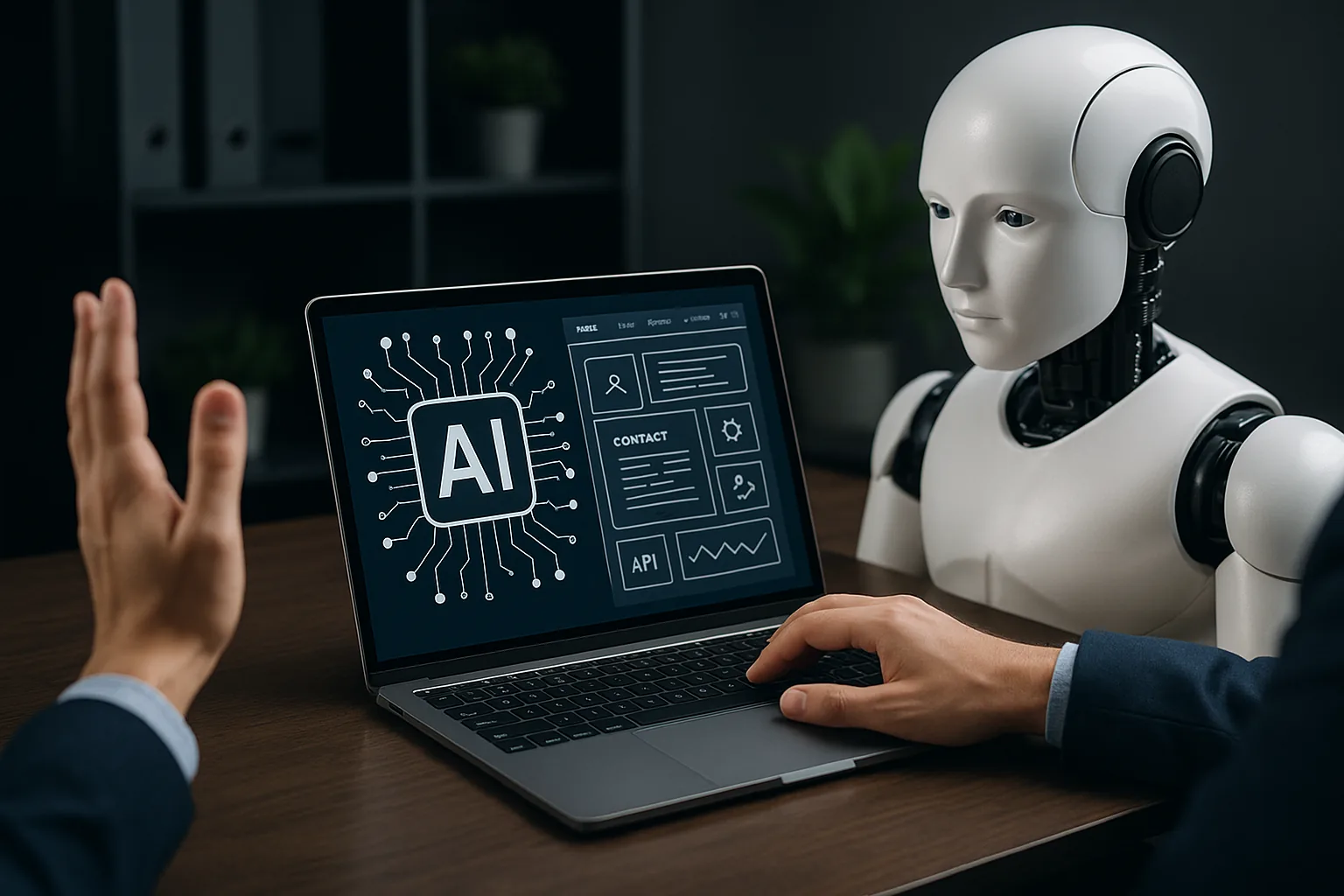
AI-Assisted vs Professional Next.js Development: When to Use AI, When to Hire a Team
Artificial intelligence has dramatically changed how websites and web systems are created. Tools powered by AI can scaffold projects, generate UI components, write API endpoints, and even recommend architecture patterns. But for businesses that need reliable, secure and scalable systems, the decision isn't just "AI or human" — it is about matching risk, complexity and business value with the right approach.
This article explains what AI does well, where human developers are still essential, compares the two approaches, provides real-world scenarios to guide your decision, and shows how combining AI with a professional Next.js development team can reduce time and cost while preserving quality.
How AI Helps Build Websites and Systems
AI tools can accelerate many parts of the development lifecycle. When applied correctly they become powerful productivity multipliers for Next.js and modern web stacks.
- Rapid prototyping: AI can convert wireframes or plain-language requirements into working UI components and pages.
- Code generation: Boilerplate code, CRUD APIs, data models and common integrations can be scaffolded by AI in minutes.
- Component libraries: AI can suggest or generate design-system components and CSS/utility classes compatible with Tailwind, CSS Modules, or styled-components.
- Test generation: Unit tests, integration tests and test data can be auto-generated to increase test coverage faster.
- Documentation: AI can generate README files, API docs and in-line comments to improve maintainability.
- DevOps suggestions: AI can produce Docker configurations, CI/CD pipelines and deployment scripts for Vercel, Cloud, or Kubernetes.
These capabilities make AI valuable for MVPs, exploratory features, and repetitive engineering tasks.
Why AI Alone Is Not Enough for Business-Critical Systems
While AI is impressive, there are fundamental business and technical areas where human expertise is required. Every business project needs careful treatment of:
Business Logic
AI can implement rules described in plain text, but translating complex, evolving business processes requires deep domain understanding.
- Edge cases: Legal constraints, industry-specific workflows, audit trails and compliance rules are often under-specified and require human validation.
- Product strategy: Prioritizing features, state transitions, rollback strategies and versioning often depends on business goals that AI cannot decide for you.
Security
Security is non-negotiable for production systems handling sensitive data.
- Threat modeling: Identifying attack surfaces, privilege escalation risks and data leak vectors requires experienced security engineers.
- Secure defaults: AI-generated code can include misconfigurations, insecure dependencies or improper auth flows if not reviewed.
- Compliance: PCI-DSS, HIPAA, GDPR and other regulations impose data handling and encryption requirements that must be validated by specialists.
Database Design and Integrity
AI can suggest schemas, but database modeling for consistency, performance and migrations is nuanced.
- Normalization vs denormalization: Choosing the right approach depends on query patterns and scalability considerations.
- Transactions and concurrency: Ensuring ACID semantics or suitable eventual consistency requires careful engineering.
- Migrations: Safe schema evolution, rollback and zero-downtime migrations are critical for live systems.
API Integration
Integrating third-party services (payment gateways, CRMs, shipping providers) often involves rate limits, error handling and reconciliation logic.
- Idempotency and retries: Robust integration handles network failures and partial updates.
- Data mapping: Aligning data models across systems frequently needs custom transformation and validation layers.
Performance
Next.js offers many performance features (SSR, SSG, ISR, edge functions). Deciding which to use depends on traffic patterns and UX goals.
- Rendering strategy: Wrong choices can harm SEO, TTFB and frontend responsiveness.
- Asset optimization: Proper image handling, caching headers and bundle splitting require engineering best practices.
Scalability
Building for scale is more than vertical scaling. It includes caching, load balancing, worker queues and database sharding.
- Cost management: Scaling must be predictable and cost-efficient.
- Distributed systems: Observability, tracing and coordination logic are critical at scale.
Maintenance and Operations
Long-term maintainability includes documentation, automated testing, deployment pipelines and monitoring.
- Upgrade paths: Dependency updates and breaking changes must be planned.
- On-call readiness: Processes for incident response and rollbacks require human teams.
Troubleshooting and Failure Modes
When systems fail, diagnosing root cause across stacks (frontend, backend, database, network) demands experienced engineers.
- Observability: Logs, traces and metrics must be instrumented and interpreted.
- Incident response: Automated systems can help but humans make judgment calls during crises.
Comparing Approaches: Build with AI Yourself vs Hire a Development Team
Below are practical pros and cons to help you decide.
1) Building with AI Yourself (Solo or Small Internal Team)
Pros:
- Speed: You can rapidly prototype and iterate at low up-front cost.
- Lower short-term cost: For simple MVPs and landing pages, AI reduces developer hours.
- Empowerment: Non-developers and product teams can validate ideas quickly.
Cons:
- Hidden risks: Uncaught security flaws, incorrect business logic and fragile integrations.
- Scalability limits: AI-generated systems often lack architecture intended for growth.
- Maintenance burden: Over time, technical debt accumulates without proper design.
Best for:
- Marketing sites, prototypes, single-feature MVPs, or internal tools with low-risk data.
2) Hiring a Professional Development Team (e.g., Next.js Experts)
Pros:
- End-to-end responsibility: Teams deliver production-ready systems with SLAs and testing.
- Architecture and governance: Teams design for security, performance and maintainability.
- Faster long-term ROI: Reduced bugs, lower TCO and predictable scaling.
Cons:
- Higher initial cost: Professional teams cost more than pure DIY AI solutions.
- Longer planning phase: Proper architecture and discovery take time.
Best for:
- Customer-facing platforms, payment systems, regulated industries, high-traffic apps.
Real-World Scenarios: Which Path to Choose
Scenario A: Launch a marketing website with a lead form
- Recommendation: Use AI-assisted tooling or templates to build a fast landing page. Keep the scope small and use form providers (e.g., Typeform) to avoid complex backend work.
Scenario B: Build a simple internal CRM for a 10-person business
- Recommendation: AI+developer hybrid. Use AI to scaffold the UI and basic CRUD, then have a developer refine security, DB schema and export/import features.
Scenario C: Online marketplace with payments and seller dashboards
- Recommendation: Hire a professional Next.js development team. You need payment integration, fraud prevention, messaging, complex business rules and scale.
Scenario D: POC of a new feature for investor demo
- Recommendation: AI-driven prototype to prove concept quickly, then plan for a rewrite with engineers if investors show interest.
Scenario E: Healthcare appointment and records system
- Recommendation: Always hire experienced developers. Compliance, audit trails and secure data storage need expert handling.
How Combining AI with Professional Developers Reduces Time and Cost
The most cost-effective approach for many businesses is a hybrid: let AI handle repetitive tasks while senior engineers focus on high-value design, security and architecture.
Tangible benefits:
- Faster delivery: AI creates scaffolding and boilerplate so developers spend more time on business logic and quality.
- Cost efficiency: Junior developers or contractors can be amplified by AI, supervised by senior engineers for architecture and security reviews.
- Better quality: With human oversight, AI-generated artifacts are reviewed, tested and hardened for production.
- Iterative product discovery: Use AI for rapid experiments and have the team convert validated experiments into robust features.
Typical hybrid workflow for Next.js projects:
- Discovery and requirements: Product and engineering define business rules, security and compliance needs.
- AI prototyping: Use AI to generate component libraries, page scaffolds and sample API routes for stakeholder validation.
- Architecture design: Senior Next.js engineers design rendering strategy (SSR/SSG/ISR), auth, caching and DB schema.
- Harden & Integrate: Engineers refine AI-generated code, add tests, set up CI/CD, monitoring and observability.
- Performance & Security review: Load tests, security audits and accessibility checks before launch.
- Ongoing maintenance: The team implements processes for updates, incident response and cost optimization.
Next.js-Specific Recommendations When Using AI
- Prefer AI for UI components, initial pages, and boilerplate API routes rather than core auth, payments or business logic.
- Use Next.js features intentionally: Incremental Static Regeneration (ISR) for catalog pages, Server-side Rendering (SSR) for personalized content, and Edge functions for low-latency APIs.
- Review AI-generated code for excessive client bundles. Optimize bundle size using code-splitting and dynamic imports.
- Protect API routes and environment variables. Never expose secrets in generated code.
- Add automated tests around any AI-generated logic before deployment.
Example: How We Use AI to Accelerate Next.js Projects (Our Process)
- Discovery sprint (1 week): Requirements, security needs, and architecture decisions.
- AI-assisted UI sprint (1 week): Generate components and pages to validate UX with stakeholders.
- Core engineering sprint (2–4 weeks): Engineers implement business logic, data models, integrations, and security hardening.
- QA, performance tuning & launch (1–2 weeks): Testing, load tests, SEO audit, final optimizations.
This hybrid approach typically reduces time-to-first-release by 30–60% compared to hand-coding every piece, while keeping production safety and scalability intact.
Why Choose a Professional Next.js Development Team (Us)
- Experience: We design production-grade Next.js apps with secure authentication, optimized performance and modern DevOps practices.
- Proven processes: From discovery to maintenance, we follow secure, repeatable processes that align with compliance needs.
- Hybrid expertise: We combine AI tooling with senior engineering judgment to deliver fast, reliable results.
- Transparent pricing and roadmaps: Clear milestones and deliverables to avoid surprises.
If you care about reliability, security and long-term scalability, hiring a professional team that uses AI strategically is the best choice.
Frequently Asked Questions
Q: Can AI build a production-ready e-commerce site on its own?
A: AI can scaffold many parts but cannot guarantee secure payment flows, fraud prevention or robust inventory handling without human oversight.
Q: How much cost savings can AI provide?
A: For prototypes and small features, AI can reduce time and cost significantly. For production-critical systems, the biggest savings come from using AI to automate boilerplate while engineers focus on core value.
Q: How do you ensure security for AI-generated code?
A: We perform code reviews, static analysis, dependency audits, penetration testing and secure configuration checks as part of our delivery.
Conclusion
AI is a powerful tool that can accelerate web development, accelerate prototyping and reduce initial costs. However, business logic, security, database integrity, API integration, performance, scalability and maintenance cannot be left entirely to AI for production systems.
For low-risk prototypes and marketing pages, AI-first approaches make sense. For customer-facing platforms, regulated industries or high-traffic apps, a professional Next.js development team is the safer path. The best ROI usually comes from combining AI with experienced engineers: AI handles repetitive work while the team focuses on architecture, security and long-term reliability.
If you're planning a Next.js project and want an approach that balances speed, cost and production readiness, contact us for a free project assessment. We help teams use AI smartly while delivering the stable, scalable systems businesses rely on.